
Animation & Agitation: The Commentary of the Political Cartoon
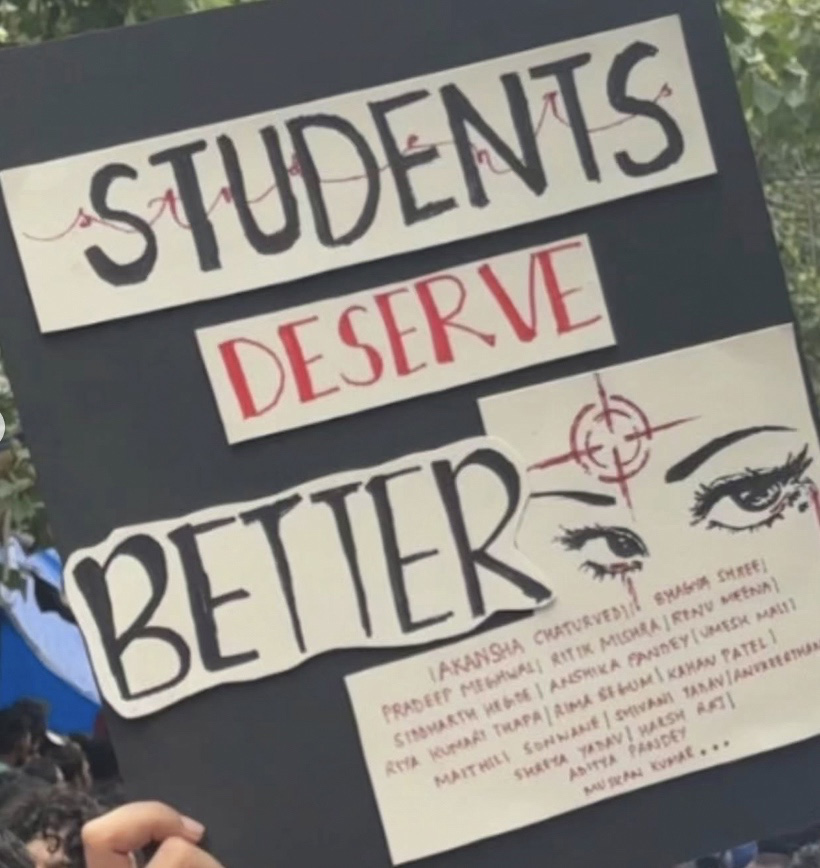
Like many citizens across India, I also found myself following the student agitations that unfolded at Jantar Mantar in New Delhi — protests that found a national momentum, with solidarity events spreading across Indian cities, before the matter was supposedly resolved. Unfortunately, as of writing this, things still seem to be simmering. However, what stayed with me, scrolling through the coverage, was not the speeches or the slogans. It was the visual language that had organised itself around the dissent: hand-drawn caricatures on placards, memes that reduced complicated arguments to a single image and a punchline, reels with hilarious political satire and witty captions.
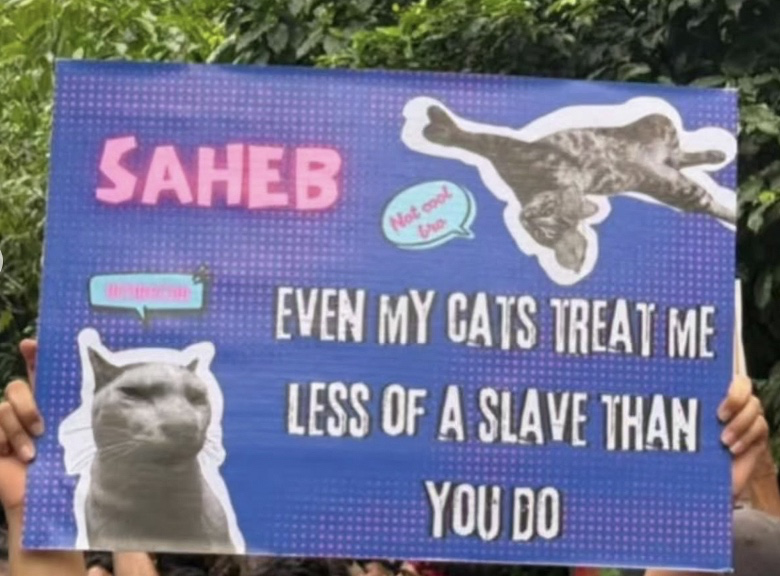
Editorial cartooning — one of the oldest forms of public commentary in the world — had shown up at the protest, looking at home in the twenty-first century. It reminded me that this form transgresses national and international boundaries. It is immortal too. All it needs is a critical moment, an open-minded audience, and something worth saying. Which brings me to the Common Man.
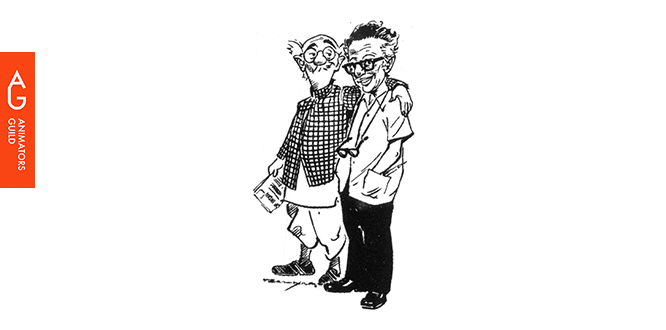
For more than fifty years, R.K. Laxman's Common Man stood in a corner of the drawn frame. Rarely, probably never, did he ever occupy the centre of the argument. He wore a checked coat that seemed too large, thick spectacles, and an expression hovering between curiosity and resignation. He was none of us while being all of us — no office, no ideology, no catchphrase. He was there at the scene, watching whatever was playing out, and I don’t recall him ever saying a word. This is what made him one of India's most perceptive commentators.
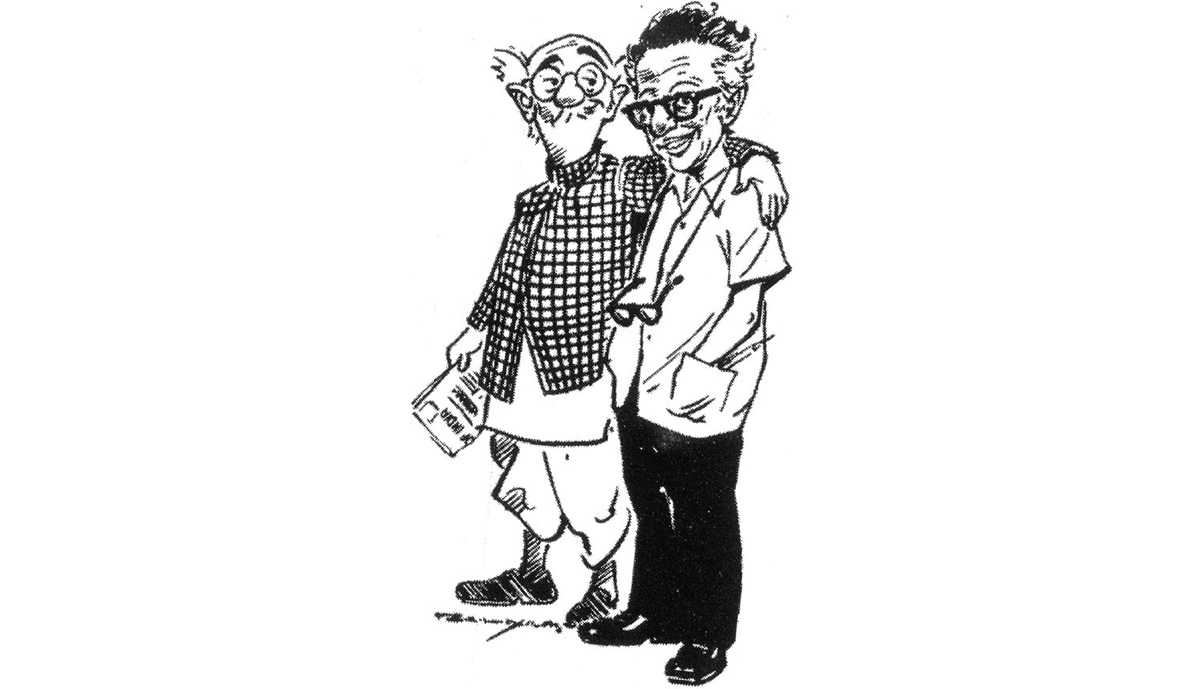
The Common Man's silence was not an absence of opinion. It was the opinion. It was breaking the fourth wall way before that was a thing. Somewhat akin to Jim from The Office looking at the camera. Mr. Laxman understood something that remains as true now as it was in 1951: the editorial cartoon does not explain a complicated situation. It presents one observation, chosen, and leaves the rest to the reader. Ministers could announce, officials could prevaricate, infrastructure could crumble with its usual fidelity. The Common Man watched. Readers supplied their own conclusions, which often included a helpless, knowing chortle.
That transfer of interpretive work — from cartoonist to reader — is what separates editorial cartooning from almost every other form of public commentary. A newspaper editorial constructs an argument, brick by brick, and hands readers the finished building. An editorial cartoon hands them the blueprint and trusts them to complete it themselves. The compression of the drawing, when it works, communicates not just more efficiently than prose, but differently — arriving at understanding through recognition rather than explanation, which is a more durable route.
For animators and illustrators, this discipline is not unfamiliar. Economy of line. Staging that communicates before dialogue begins. Silhouettes that establish character before the details. The editorial cartoon operates inside the same constraints: every mark must justify itself, and everything that doesn't serve the idea has to go. The process is less like writing a sentence than like editing one until the essential verb remains.
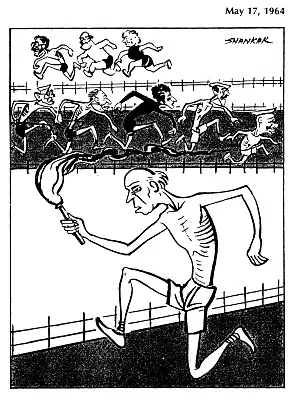
Before India had a tradition of editorial cartooning, it had Keshav Shankar Pillai.
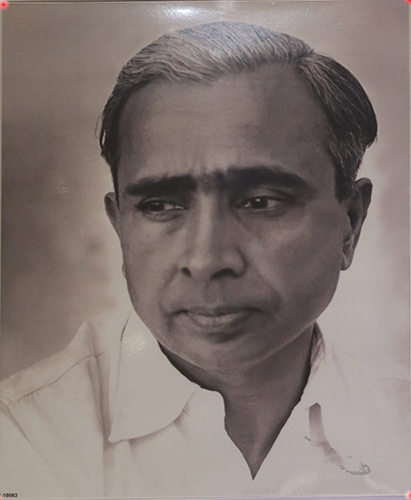
When Shankar's Weekly began publication in 1948, the country was still deciding what its public institutions would look like, what press freedom would mean in practice, and whether satire belonged in serious journalism or beside the crossword. Shankar made the argument through the work itself. His caricatures were pointed without being vindictive, but his more lasting contribution was curatorial. He encouraged younger artists while refusing to impose a house style, which meant that Indian editorial cartooning developed not as a single tradition but as a set of individual voices in conversation.
The anecdote most associated with Shankar concerns India's first Prime Minister, who is remembered as telling him: "Don't spare me, Shankar." Whether the words have been polished in the retelling is almost beside the point. The story persists because it describes something a democracy requires — public figures who understand that satire is not a threat to authority but a measure of its confidence.
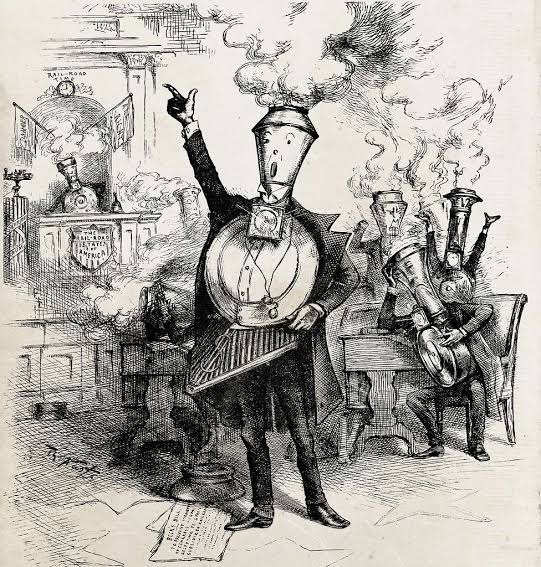
This was, of course, not uniquely Indian. Thomas Nast's cartoons in Harper's Weekly in the 1870s helped bring down Boss Tweed's corrupt political machine in New York — not through reporting, but through caricature so recognisable that even voters who could not read understood it.
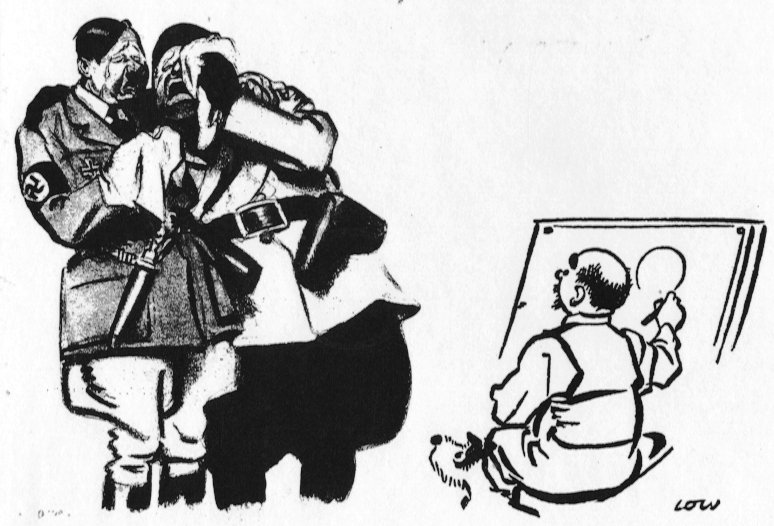
David Low's Nazi leaders’ caricatures in the London Evening Standard through the 1930s were considered threatening enough that they became a minor point of diplomatic friction between Britain and Germany.
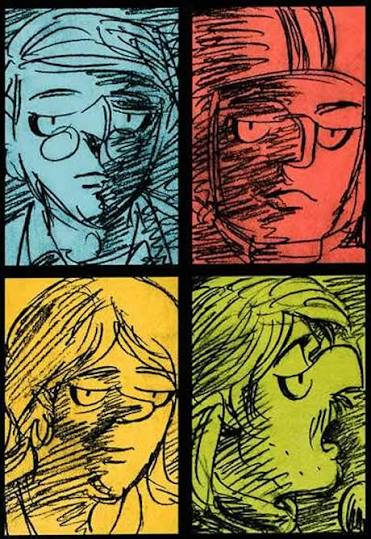
Garry Trudeau's Doonesbury became the first comic strip to win a Pulitzer Prize for Editorial Cartooning, which irritated newspaper editors who felt the prize category was being appropriated by someone who drew fictional characters but kept finding their way into genuine political consequence.
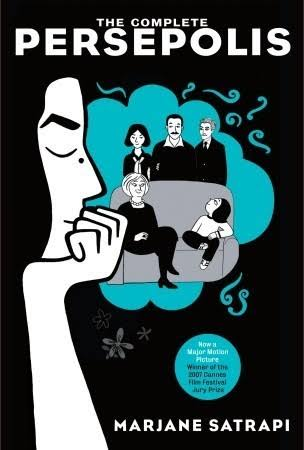
The late, great Marjane Satrapi's Persepolis — a memoir of growing up during the Iranian revolution, drawn in stark black and white — demonstrated something further: that the compressed visual language of cartooning could carry not just regular commentary but sustained personal and political testimony. The form, in her hands, became a document, an even more relevant one in the present.
In other words, the medium has always had a reach that exceeds what its modest format should allow.
What Mr. Laxman understood was that reach depended on the subject. Earlier political cartoons in India, as in most countries, tended to revolve around politicians. Mr. Laxman shifted the focus toward the citizen, expected to live with politics after the speeches had finished. He was interested not in what governments announced but in what those announcements felt like to the person waiting at a bus stop in Puducherry or standing in a queue at a government office in Patna.
The Common Man was never a hero. He did not expose anyone or deliver any verdicts. He lived in the same ordinary space as his readers, which meant that readers recognised themselves in him — their own bewilderment, their own patience, their own resigned familiarity with systems that were both ambitious and exasperating. A leaning electric pole, a cracked wall, a cluttered desk: Mr. Laxman could establish an entire argument through a single object placed in the background. Nothing in his drawings existed for decoration and every detail worked. Very hard, at that.
This is where editorial cartooning demands the same thinking that separates good character design from competent character design. Visual hierarchy — what draws the eye first, what rewards a second look, what fades into context. Mr. Laxman's compositions were deceptively simple in the sense that the thinking behind them was not simple at all. He made decisions about emphasis that look obvious in retrospect, which is the mark of any visual storytelling that has been resolved rather than executed.
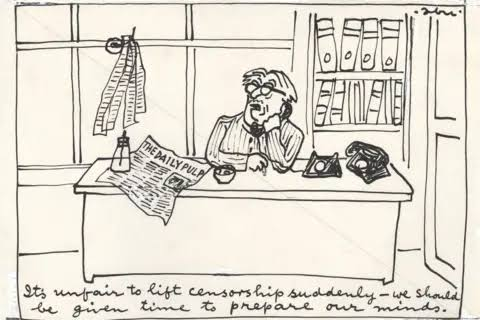
As Indian editorial cartooning developed through the post-independence decades, its expanding cast demonstrated that the medium could accommodate almost any sensibility.
Abu Abraham, who had worked for The Observer in Britain before returning to India, brought an international dryness to Indian public life — his cartoons assumed readers who could appreciate understatement, whose pleasure came from an argument so subtle it bordered on inaudible.
Abu Abraham, who had worked for The Observer in Britain before returning to India, brought an international dryness to Indian public life — his cartoons assumed readers who could appreciate understatement, whose pleasure came from an argument so subtle it bordered on inaudible.
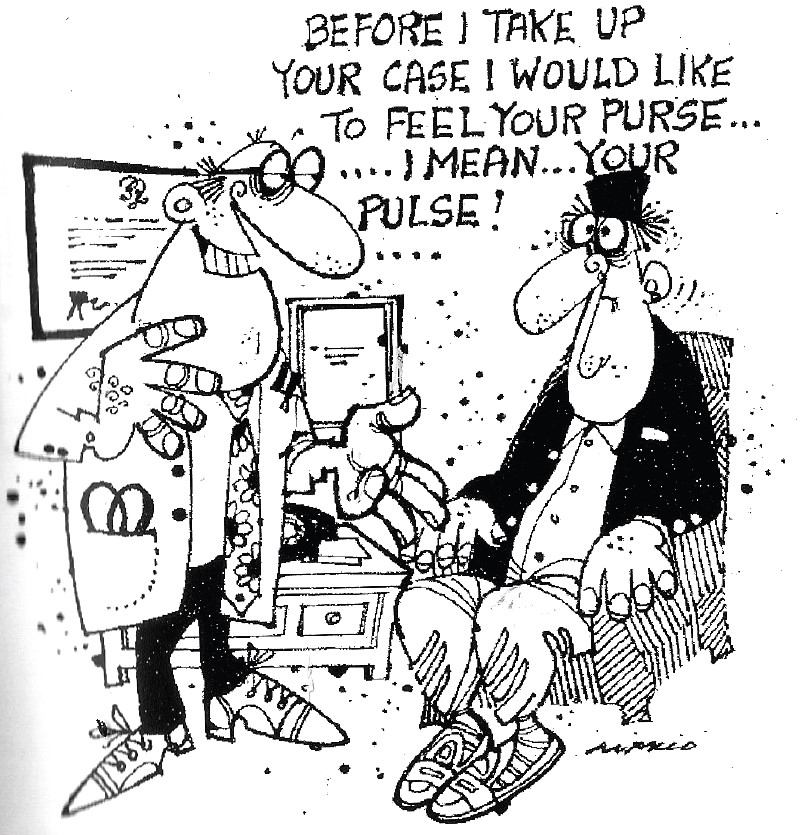
Mario Miranda moved in an almost opposite direction: his crowded Goan restaurants and overflowing Bombay streets contained what seemed like fifteen stories happening at the same time, social comedy observed at such density that a single drawing could hold an entire neighbourhood. Rajinder Puri built a reputation by refusing political convenience — his cartoons aligned with no comfortable position, which made them independent at a time when independence required some effort to maintain. Kutty understood that clarity was a journalistic virtue in itself: readers should be thinking about the idea within the first second of looking, not working to decode the drawing. O.V. Vijayan brought literary seriousness and philosophical depth to political cartooning in a way that expanded the form's ambitions. Ajit Ninan combined elegance with contemporary relevance across decades of newspaper work.
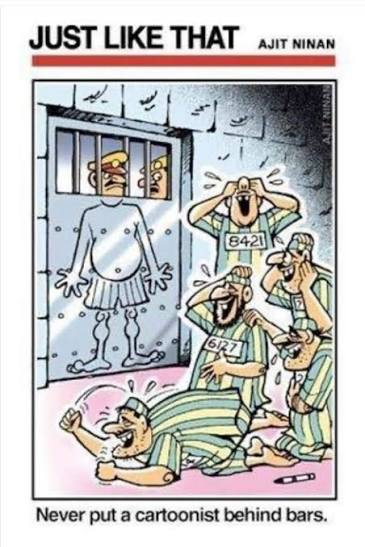
Collectively, these artists accomplished something that took readers some time to notice: they had each developed a visual signature so distinct that, across much of the twentieth century, regular newspaper readers could identify Indian cartoonists from the rhythm of a line before they reached the signature in the corner.
Few exemplified that individuality better than Sudhir Tailang. Born in Bikaner, Tailang had work appearing in print while he was still a teenager — an almost implausible level of early assurance that never subsequently faltered. He moved from Hindi publications into English-language national newspapers, a trajectory that reflected both his ambition and a broader shift in how editorial cartooning was finding its audiences. His caricatures were decisive without being hurried; faces were simplified without losing their particular vanity, or uncertainty, or self-satisfaction. The Rajasthani influence in his brushwork gave his lines a calligraphic quality that was immediately recognisable — which is what E.P. Unny was describing when he observed that Tailang rarely needed to sign his work.
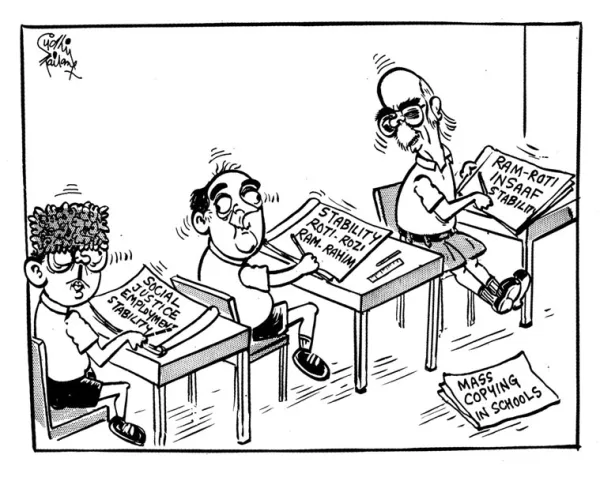
Tailang himself returned often to what he considered the actual discipline of the profession: roughly seventy per cent of a cartoon's success resided in the idea, and the remaining thirty in the execution. This proportion might be argued with, but the underlying principle cannot. A beautifully rendered drawing built around a weak observation is forgotten with the edition. A rough sketch carrying an unforgettable insight can survive for decades. Every editorial cartoonist who has worked at the form seriously eventually discovers this — the drawing stops the eye. The idea is what stays. Impact from the get go.
E.P. Unny has spent his career demonstrating how far that insight can be extended. Known first as an editorial cartoonist, Unny has also worked as an illustrator, graphic storyteller and informal chronicler of the profession — a body of work that treats editorial cartooning not as a narrow journalistic format but as one expression of a much larger visual intelligence. His career argues, through its variety, that the discipline of compression applied to daily news is related to the discipline of compression applied to a graphic novel, or a book illustration, or any other form that must say something specific in limited space.
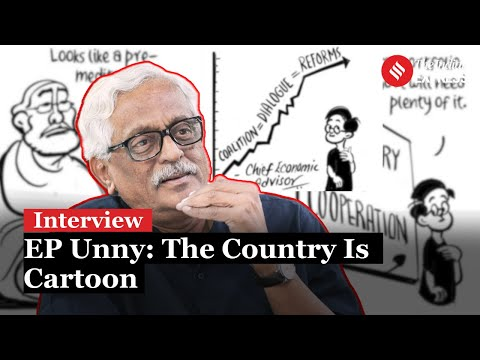
That argument matters more now than it did when Unny began. For most of the twentieth century, the editorial cartoon occupied a structurally privileged position: it appeared in a physical newspaper, which was read by a large shared audience, at the same time each morning. A drawing published at breakfast might become the subject of three separate conversations before lunch. That shared rhythm gave cartoonists something that is now harder to find — a common cultural moment, a guaranteed simultaneity of reception.
Bill Watterson, reflecting on the contraction of newspapers in the context of comic strips rather than editorial cartoons, identified what was disappearing: not the audience, but the shared experience of an audience. When Calvin and Hobbes ran in its prime, hundreds of millions of readers encountered it under the same conditions, in the same physical format, at the same point in their day. Watterson's eventual decision to retire the strip rather than license it for merchandise was inseparable from his understanding that the strip's meaning was bound to those specific conditions of reading. When the conditions changed, something changed with them.
Editorial cartooning confronted the same transformation, and what is interesting is how little it changed the medium's core logic.
Satish Acharya's career illustrates this. Where earlier generations built their identities through individual newspapers — their work arriving within an editorial structure, distributed through institutional channels — Acharya's work moves across publications and digital platforms with a fluency that depends on neither. An image published at noon can reach readers in several countries by evening. The cartoonist is no longer exclusively a member of a newspaper's editorial staff but something closer to an independent voice with direct access to an audience.
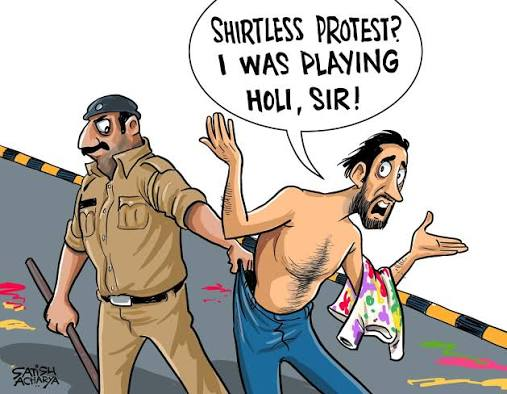
If Satish Acharya represents how the individual cartoonist adapted to the digital age, the COVID lockdowns showed what happens when that adaptation happens collectively and fast.
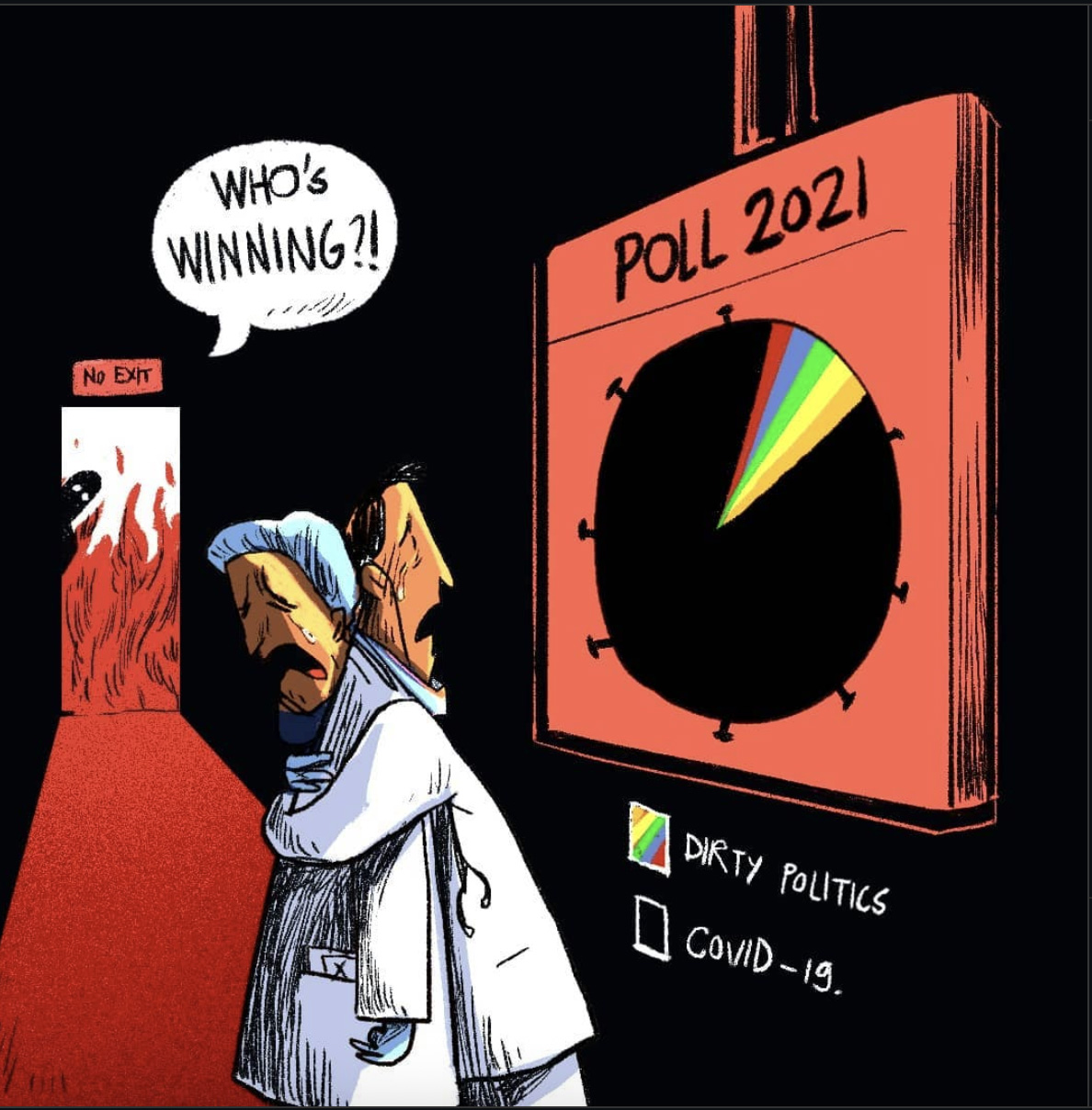
The above examples illustrate that the digital environment, for all its noise, has reinforced rather than diluted the qualities that made editorial cartoons effective. An image or animated video fighting for attention among ten thousand other images needs to communicate right then and there. It needs to be clear before it can be clever, and precise before it can be surprising. The internet rewards compression in ways that long-form content often cannot. A cartoon that required you to pause and think — because it was doing enough visual work to make the pause worthwhile — turns out to be well suited to an environment where pausing is voluntary.
This is the paradox of editorial cartooning's digital migration: the medium that looked most threatened by the collapse of the newspaper habit may have found in that collapse an unexpected validation. Its central competence — the distillation of a complicated public reality into a single, intelligible image — is not less valuable in an attention-fragmented world. It is more so.
Visual storytellers thinking about what their medium can carry should consider this. Editorial cartooning's history is full of announced endings: photography would make it redundant, television would displace it, twenty-four-hour news would outpace it, the internet would overwhelm it. The medium survived each of these predictions without ever becoming defensive about its survival, because it was never competing with those other forms on their terms. It was doing something they could not: presenting one observed truth, leaving just enough unsaid, and trusting the reader to make the connection.
Have our public institutions and individuals provided rich material for the editorial animator? Absolutely.
In the end, trust is what this particular form has always been selling. Though both matter, it’s not the elegance of the line or the sharpness of the caricature but the particular pleasure of understanding something through a drawing that you could not quite have articulated in words. The reader does the final work. The cartoon makes that work feel like discovery.
Shankar established that such work deserved a serious home. Mr. Laxman moved the subject from power to the experience of living under it. Tailang demonstrated that a recognisable style, far from constraining ideas, could become the instrument through which ideas arrived with greater force. Unny showed the form continuing to think about itself. Acharya shows it moving.
Shankar established that such work deserved a serious home. Mr. Laxman moved the subject from power to the experience of living under it. Tailang demonstrated that a recognisable style, far from constraining ideas, could become the instrument through which ideas arrived with greater force. Unny showed the form continuing to think about itself. Acharya shows it moving.
What hasn't moved is the basic transaction: cartoonist and reader, image and understanding, with something left in the space between them for the reader to find. Whether that space is a newspaper page, a hand-drawn placard at Jantar Mantar, a viral meme on Reddit or something a stranger made at midnight and posted before anyone told them not to on Instagram — the form holds. It has always held, because it was about the one thing no algorithm has yet figured out how to replace: someone looking at what is happening, deciding what it means, and trusting you to see the tragicomic element in it too.